Elaine Ayala
Ayala: Honoring a soft-spoken icon

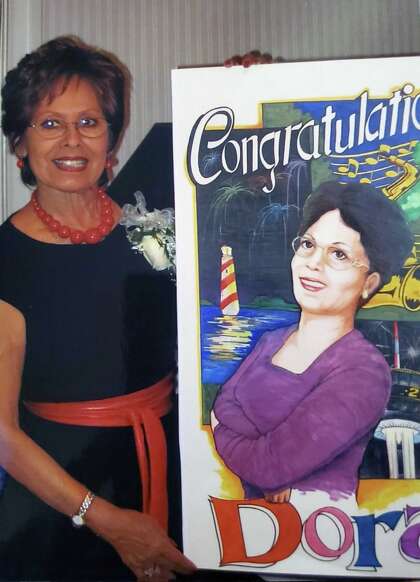
By many accounts, Aurora “Dora” Jordan wasn’t a flashy person. In her youth, she might have been crowned reina of a South Side nightclub known as “El Ranchito.” No doubt she loved music and dancing. After all, she married into a famous musical family.
But Jordan preferred being backstage, where detail work ensured the success of every event she helped plan.
She
was involved in a lot of them, from San Antonio’s New Year’s Eve
celebrations when they were first held in front of the Alamo to
Jazz’SAlive festivals at Travis Park.
All the stories, all the time
Unlock Express News for 95¢
She
oversaw the details of dedications for new parks. She organized social
events and served as a translator when the presidents of six Latin
American countries came to San Antonio in 1992.
As
a special events coordinator for the city’s Parks and Recreation
Department, she was the first to arrive to make sure the correct streets
were closed and the last to leave after overseeing the work of cleaning
crews.
Jordan had been retired for years when she died
in July at 75, another victim of the coronavirus pandemic. The
elaborate funeral she planned was not to be — “due to COVID-19,” as her
death notice said.
Since then, three of her friends — Mary Ellen Rodriguez, 82, Grace Herrera, 82, and Angie Perez, 70 — have being talking about having a park named for Jordan.
The process is long and arduous, requiring petitions, hearings and even door-to-door campaigns in a park’s neighborhood.
It
will be a while before the project develops legs, though several
influential people, including activist Rosie Castro, are already behind
the initiative.
That’s
because they knew the woman Jordan was — dedicated, demanding,
deserving. They know she was a person who, in her own day, wouldn’t have
been considered for such an honor.
In that era, schools, libraries, streets, parks and arenas rarely were named for deserving women, especially women of color.
But
it’s a new day, and the nation is being forced to reckon with a history
of slights, injustices and racism. A new willingness has emerged not
only to consider such overdue acknowledgment but to will it into
reality.
Jordan
was like so many young, ambitious Mexican American women in San Antonio
in the 1950s, ’60s and ’70s. They had to work so much harder for what
they achieved.
They
were smart and capable but weren’t always able to go to college. But
once hired, they figured out how to survive and succeed.
They
were Rosie the Riveter types who listened when they were told to learn
to type because it was going to come in handy someday. They pushed each
other to take college courses and looked out for one another when job
openings were posted.
They
couldn’t become generals or directors of departments, but they took
notes, sometimes literally, because they had mastered an archaic
language called shorthand and took dictation.
As
the “Hamilton” song goes, they were in the rooms where decisions were
made, and they learned it wasn’t so hard to make things happen.
Carol
O’Malley, who worked for the parks department and later operated a San
Antonio river barge company, remembered when Jordan was involved in
planning dignitary visits, including that of Pope John Paul II in 1987,
and in bringing Mexican songstress Lola Beltrán to San Antonio for a
concert benefiting parks.

Jordan
was briefly married to professional percussionist Bonifacio Jordan,
brother of the late accordion legend Esteban “Steve” Jordan.
Her
son, also named Bonifacio Jordan, said his mother died a month after
her sister’s death, also of COVID-19. It has been a trying couple of
months for the family. They’re touched by the thought of having a park
named for her, but they haven’t gotten their hopes up.
But
if you ask Rodriguez, Herrera and Perez, many city government retirees
are just as interested in seeing Dora Jordan receive her due.
They’ve
all been in the rooms where decisions are made, and they think it’s
probably best if city officials just get behind them.
They already have a piece of undeveloped parkland in mind, and they don’t sound like women who’ll take “no” for an answer.
Dora Jordan was like that.
They recalled how she encouraged other women to get ahead, apply for better jobs, report injustices and speak up for themselves.
“She’d say, ‘No te dejes,’”
said Perez, using a Spanish phrase that’s loaded with attitude and that
advises the hearer to speak up, defend themself, don’t get discouraged
and don’t accept defeat.

No comments:
Post a Comment